Meet Your AI Career Twin
What if a recruiter could talk to you before they ever talked to you?
Not a chatbot reciting bullet points from a resume. Not a portfolio page with dead screenshots. An AI that knows your career — your projects, your achievements, your professional history — and refuses to make anything up.

The Real You

Your AI Career Twin
That is DigitalMe. You build a corpus of career documents — project write-ups, achievement logs, skills inventories, publications — and the system creates an AI twin that speaks only from that evidence. Visitors ask questions. Your twin answers with citations. If it cannot find the answer in your documents, it refuses rather than guesses.
A Window Into Your Career
The widget is a small chat bubble that sits on your personal site — your portfolio, your consulting page, your professional landing page.1 A visitor clicks it, signs in with LinkedIn, and starts a conversation with your digital twin.
Think of it as a window. On the other side stands an AI that has read everything you have written about your career. The visitor asks a question — "What experience does this person have with distributed systems?" — and the twin searches your corpus, finds the relevant passages, and answers with specific citations.2
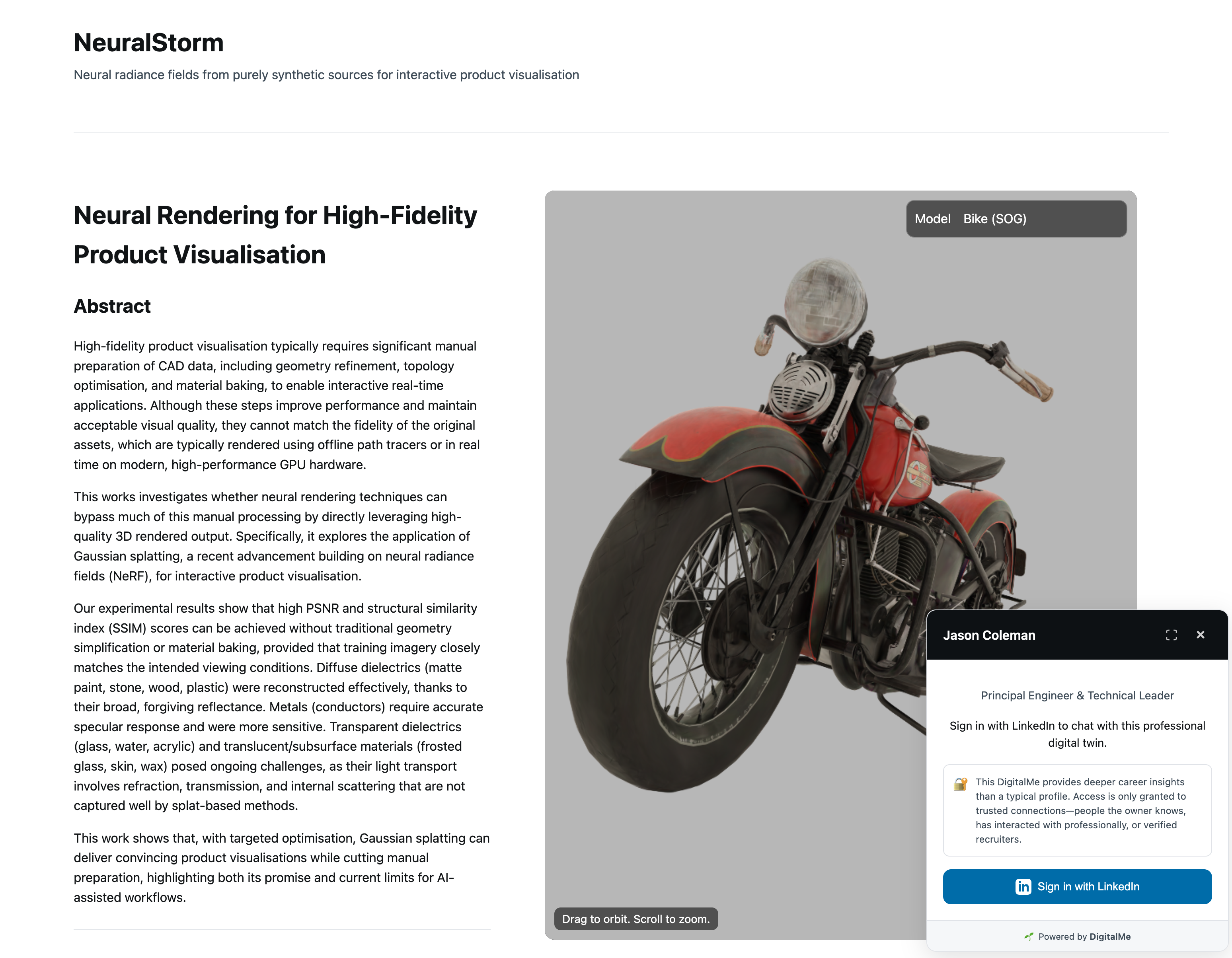
The visitor sees a conversation. What they do not see is the engine underneath — semantic search across your entire career corpus, multi-layered citation verification, and scope enforcement that keeps every exchange strictly professional.
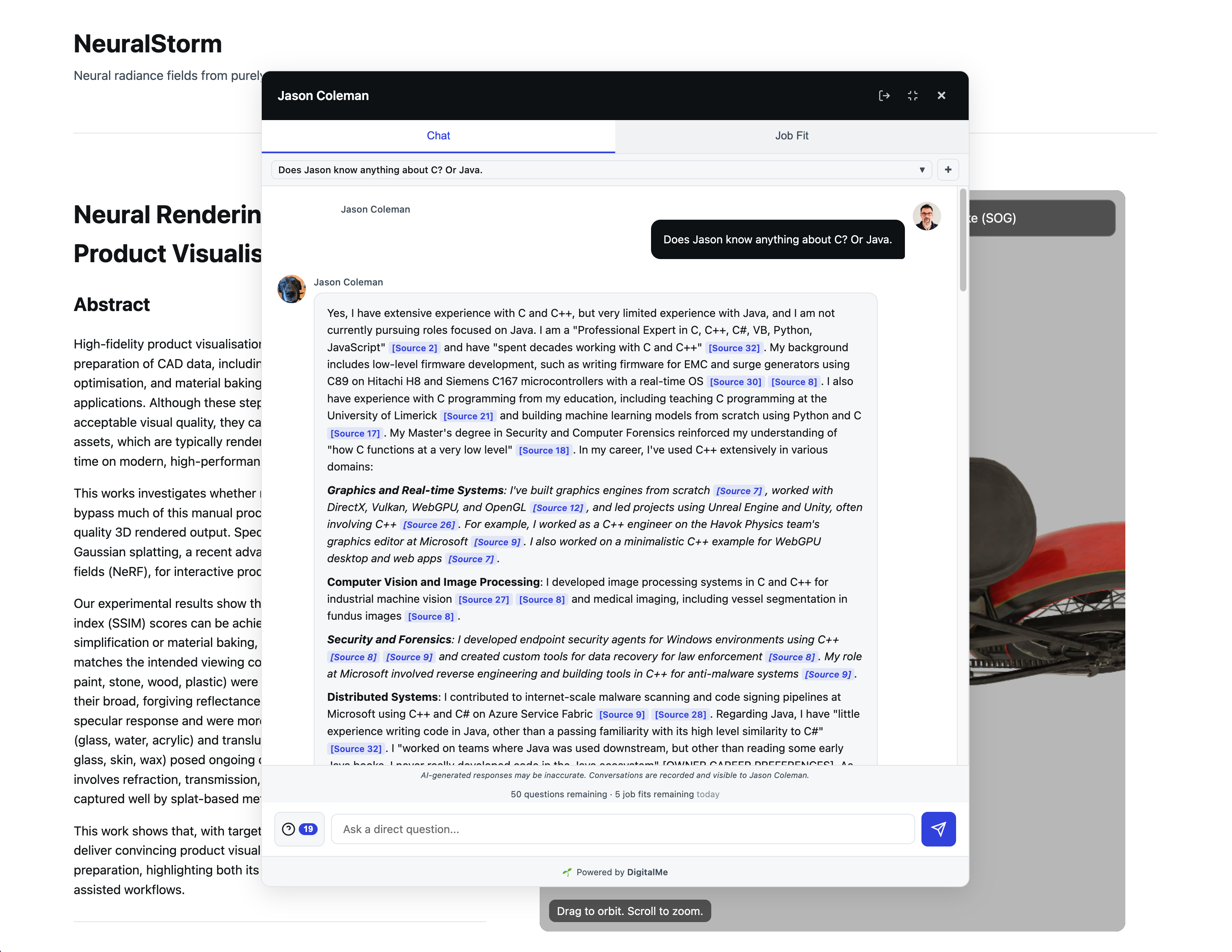
Access On Your Terms
The LinkedIn sign-in is not just authentication. It is the first step of access control. You decide who gets to talk to your twin, and you can revoke that access at any time.
You also see every question a visitor asks. This is deliberate. Hiring is a two-way street. The questions reveal what matters to the person asking — where their priorities lie, how they think about the role.3 The visitor evaluates you. You evaluate them.
Your Site, Your Context
The widget sits on your page, surrounded by your work. A visitor reads your case studies, browses your projects, and opens the widget to dig deeper. The context of your site frames the conversation.4
You do not have to embed the widget on your own site. DigitalMe has a portal where visitors can find you, chat with your twin, and run job-fit analyses directly. But the widget on your own site turns a static portfolio into an interactive one. It lets visitors ask the questions a portfolio cannot anticipate.
What Holds It Together
Your digital twin exists for one purpose: to present and evaluate professional skills and experience. It discusses your projects, your skills, your achievements, your career trajectory — and nothing else. Not politics, not religion, not personal matters. Questions about compensation get a respectful redirect — those conversations should happen directly between people.5
The twin cannot fabricate skills. It cannot inflate experience. It speaks only to what you have documented. And when it generates documents — tailored CVs, cover letters, LinkedIn outreach messages — every output is checked against the raw corpus before you see it.
How that verification works is a story in itself →
Try DigitalMe
It is early days, and I am genuinely interested in the feedback. There are two ways to try it:
Build your own — join the waitlist. I want to understand who finds this valuable and why.
Talk to mine — Visit neuralstorm.io, open the widget, and sign in with LinkedIn. Then DM me on LinkedIn — let me know who you are and what brings you here, and I'll grant you access.
Notes
- The embed is two lines: a script tag and an init call. The widget appears as a floating chat bubble in the corner of any page. ↩
- Every answer cites the source document, the passage, and the location within that passage. If a cited quote does not exist in the source material, the system rejects it. ↩
- The visitor evaluates the candidate. The candidate evaluates the visitor. Both sides learn something from the exchange. ↩
- A visitor who has just read about a specific project can ask the widget for details about the decisions behind it. The answer comes back with citations to the relevant career documents. ↩
- The work-only scope is enforced through multiple layers of the architecture, from input moderation through to output validation. This is not a content filter bolted on afterward. It defines what a career twin is for. ↩