Both Sides of the Table
DigitalMe serves two audiences. It treats them with equal transparency.
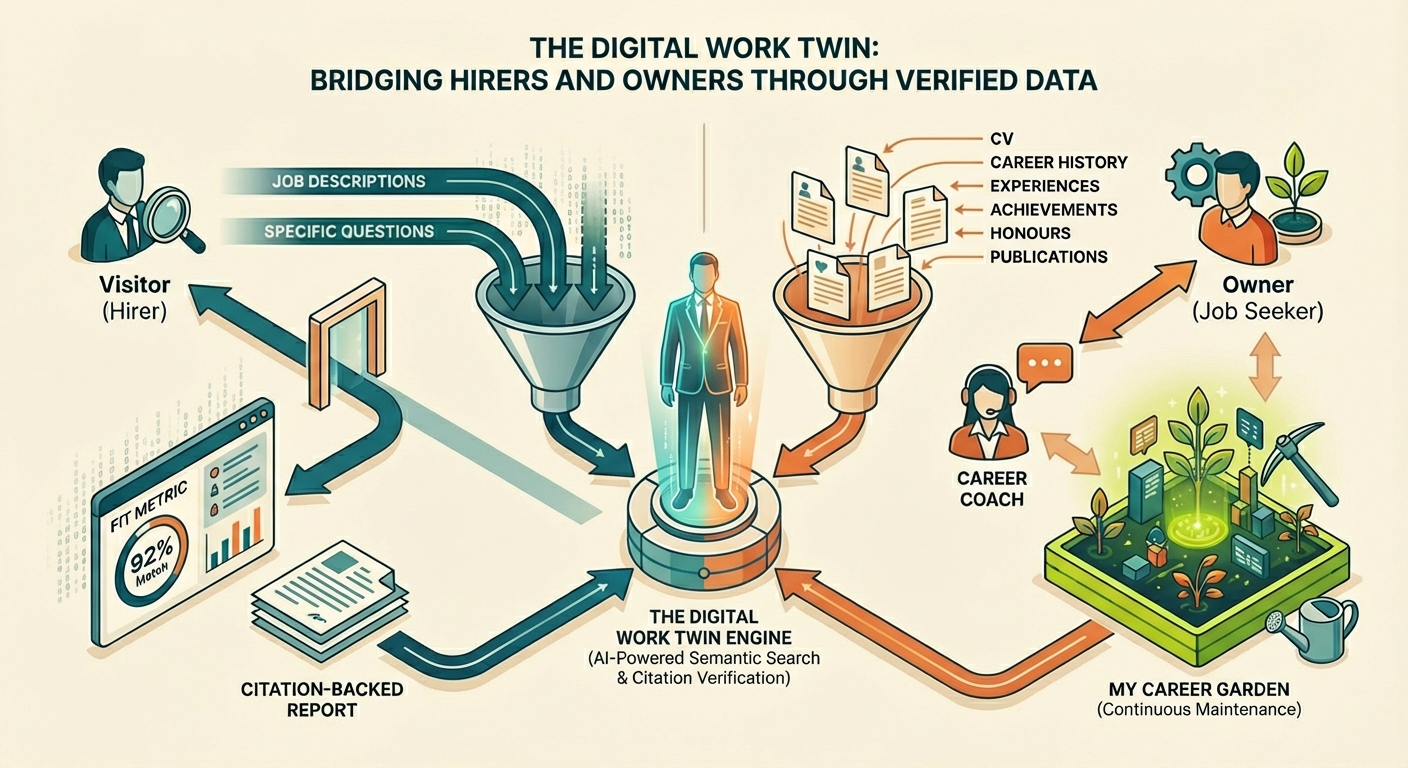
On one side: visitors — hirers, recruiters, founders looking for co-founders. They bring job descriptions and pointed questions. On the other: owners — professionals who have built a career corpus and let an AI twin represent it. Between them stands a system that shows both sides the same evidence and hides nothing.
The Visitor's View
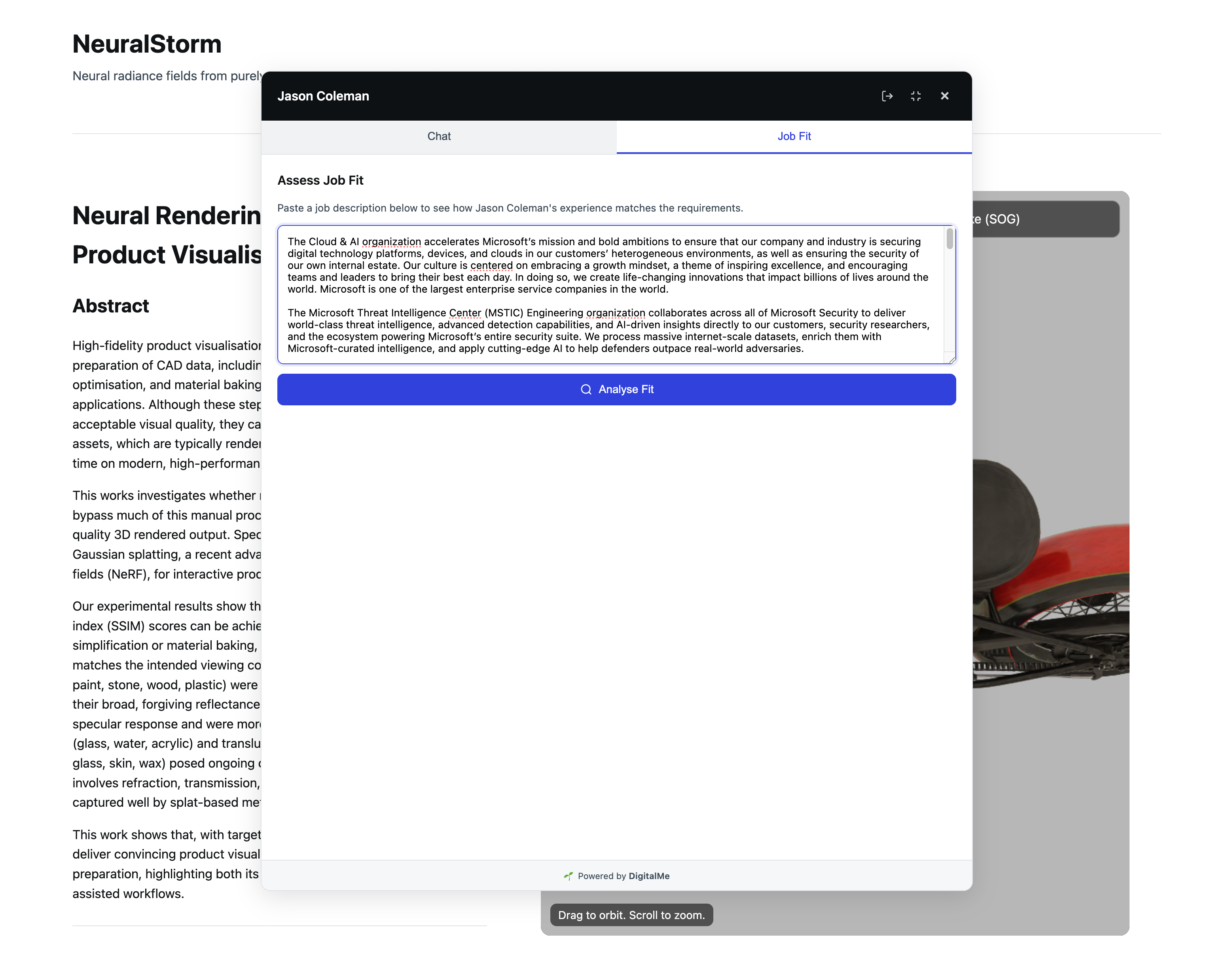
A visitor pastes a job description. The system extracts requirements and searches across all registered professionals using a multi-stage matching process.1 The result is a ranked list of candidates with detailed breakdowns: strong matches, partial fits, and gaps — each backed by cited evidence.
Visitors can chat with any candidate's digital twin. They can ask specific questions and get citation-backed answers. They can also run a job-fit analysis against a single candidate — paste a job description, hit analyse, and the system returns a match score with a full skills breakdown.2
The analysis comes back with a match score, a recommendation, and a detailed breakdown of every requirement — strong matches with cited evidence, and gaps where the corpus falls short.
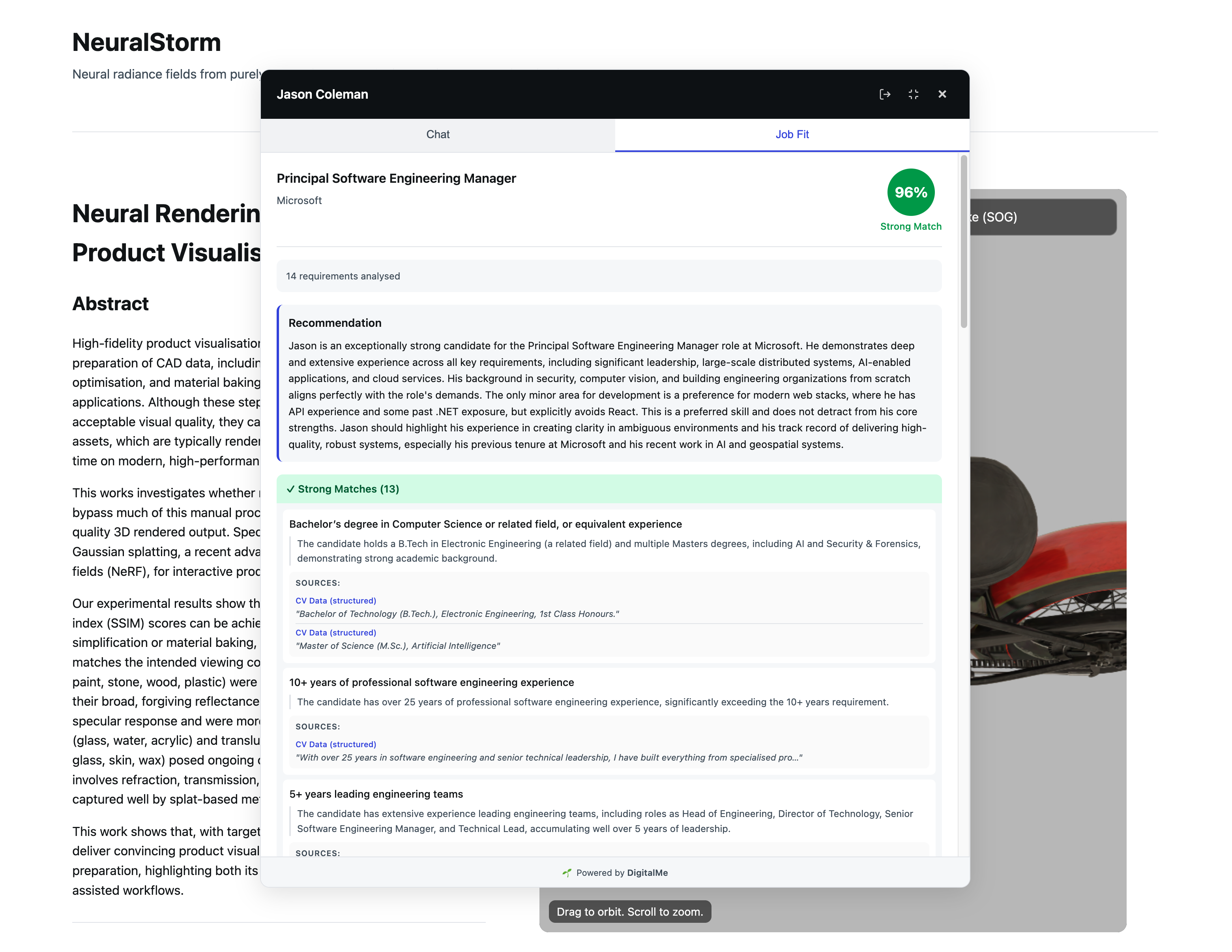
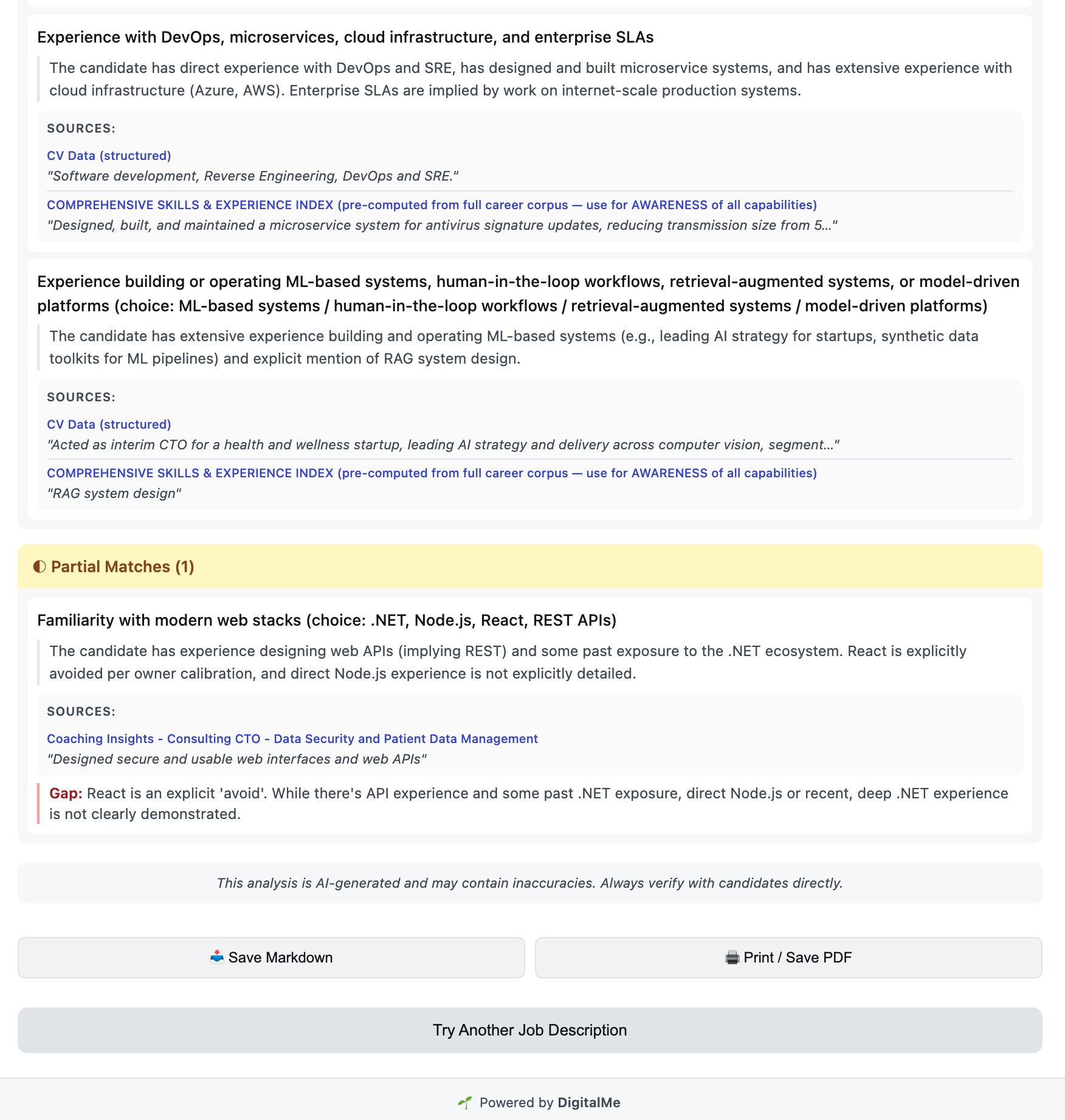
Every answer cites the source document, the specific passage, and the location within that passage. If the twin cannot answer from the corpus, it refuses.
The Owner's View
Owners see the same analysis — and more.
Three actors work together on the owner's side. The Owner uploads documents, calibrates skills, and maintains the corpus.3 The Career Coach — an AI-powered tool — helps the owner articulate their experience: parsing uploaded CVs, asking probing questions about forgotten details, extracting structured insights with measurable outcomes and concrete specifics. The Digital Twin is the outward-facing AI that answers from the corpus the owner and the coach have built together.
These three form a pipeline. The owner feeds raw material. The coach shapes it into a structured, searchable corpus. The twin presents it to the world with citations and evidence.
From Analysis to Action
From the owner's dashboard, a job description becomes the starting point for a full gap analysis. The system compares the role's requirements against the owner's CV and broader career corpus. It shows exactly where the profile falls short. Then it acts on that analysis.
The system drafts a tailored CV that foregrounds the most relevant experience, a cover letter that connects documented achievements to the role's specific requirements, and a LinkedIn outreach message grounded in real skills.4
These are not final documents. They are frameworks — starting points the owner refines with their own voice and judgement.5 The system does the heavy lifting. The owner does the final shaping.
The Future of Work Is Fluid
The era of thousands of engineers in one building is ending. The future belongs to highly mobile, product-focused engagements where talented people flow between projects and ventures. Founders find founders. Skills match problems, not headcount.
DigitalMe exists for this future. Your professional story works around the clock. It handles the fact-finding so that when you finally sit down together, you are already past the surface and into what matters.
Your DigitalMe cannot lie for you. Everything it says must be verified in person, just like always.6 But now the fact-finding happens before the first meeting, not during it.
The widget on your page — that small, embeddable chat bubble — is the visible surface. Beneath it runs a career engine built on verified documents, citation-backed analysis, and a garden you tend as your career grows.
The widget is the tip of the iceberg. The iceberg is your career.
Try DigitalMe
It is early days, and I am genuinely interested in the feedback. There are two ways to try it:
Build your own — join the waitlist. I want to understand who finds this valuable and why.
Talk to mine — Visit neuralstorm.io, open the widget, and sign in with LinkedIn. Then DM me on LinkedIn — let me know who you are and what brings you here, and I'll grant you access.
Notes
- The first stage filters on broad professional dimensions — discipline, domain, skills, experience, achievements. The second performs deep analysis against each candidate's full career profile. ↩
- The analysis produces a structured assessment: a percentage match, a recommendation, strengths with cited evidence, partial matches, and gaps — including any skills the owner has flagged as dealbreakers. ↩
- Calibration means the owner can mark skills as overstated, stale, learning, or avoid. These signals flow into every analysis — discovery, job fit, and CV generation. ↩
- Every generated document passes through post-generation verification. Skills that appear in the output but not in the corpus are removed before the owner sees the draft. ↩
- The gap analysis tells the owner where they are strong and where they fall short. The tailored CV, cover letter, and LinkedIn message are drafts built on that analysis. The system does the heavy lifting of aligning a career to a specific role. The owner does the final shaping. ↩
- This is AI — tuned for honesty and citation-backed answers, but not infallible. Use the output as talking points for when you actually speak to the person. The system eliminates surface-level fact-finding, not the need for human conversation. ↩